Top 5 Coping Skills Taught in Group Therapy Activities
The five coping skills most often taught in group therapy activities are grounding, emotional awareness, healthy communication, cognitive and dialectical behavior tools, and relapse prevention planning. These skills help you stay present, name what you feel, speak up without spiraling, and bring recovery into daily life. Key Takeaways Grounding techniques for anxiety help you stay […]


The five coping skills most often taught in group therapy activities are grounding, emotional awareness, healthy communication, cognitive and dialectical behavior tools, and relapse prevention planning. These skills help you stay present, name what you feel, speak up without spiraling, and bring recovery into daily life.
Key Takeaways
- Grounding techniques for anxiety help you stay in the room when panic, cravings, or shame start to rise.
- Emotional regulation skills make it easier to notice triggers early, especially when depression and addiction or anxiety and addiction overlap.
- Healthy communication in recovery supports repair, boundaries, and calmer conflict with family, peers, and employers.
- Cognitive behavioral therapy coping skills and dialectical behavior therapy exercises help you interrupt old reflexes and choose a safer response.
- Relapse prevention skills turn group practice into a real plan for home, work, and aftercare in South Florida recovery.
-
Grounding Yourself in the Room When Everything Feels Too Loud
Grounding is one of the first coping skills I teach because it works fast when your nervous system starts to tip. In group therapy activities, grounding helps lower panic, cravings, and shame enough to stay engaged instead of shutting down or leaving the room.
Why grounding works when panic, cravings, or shame start to spike in group therapy activities
Grounding gives your brain a simple job when emotions feel bigger than the moment. That matters in peer support in recovery groups, where hearing someone else’s story can stir up old memories or a sudden urge to use. I usually tell clients that grounding is not about forcing calm; it is about getting back into the present long enough to make a wise choice.
One person I worked with in Delray Beach could not sit through check-ins without scanning the room for an exit. We practiced a brief reset before group: feet on the floor, shoulders down, one slow breath, and naming three objects in the room. Within a week, they were still anxious, but no longer disappearing after five minutes.
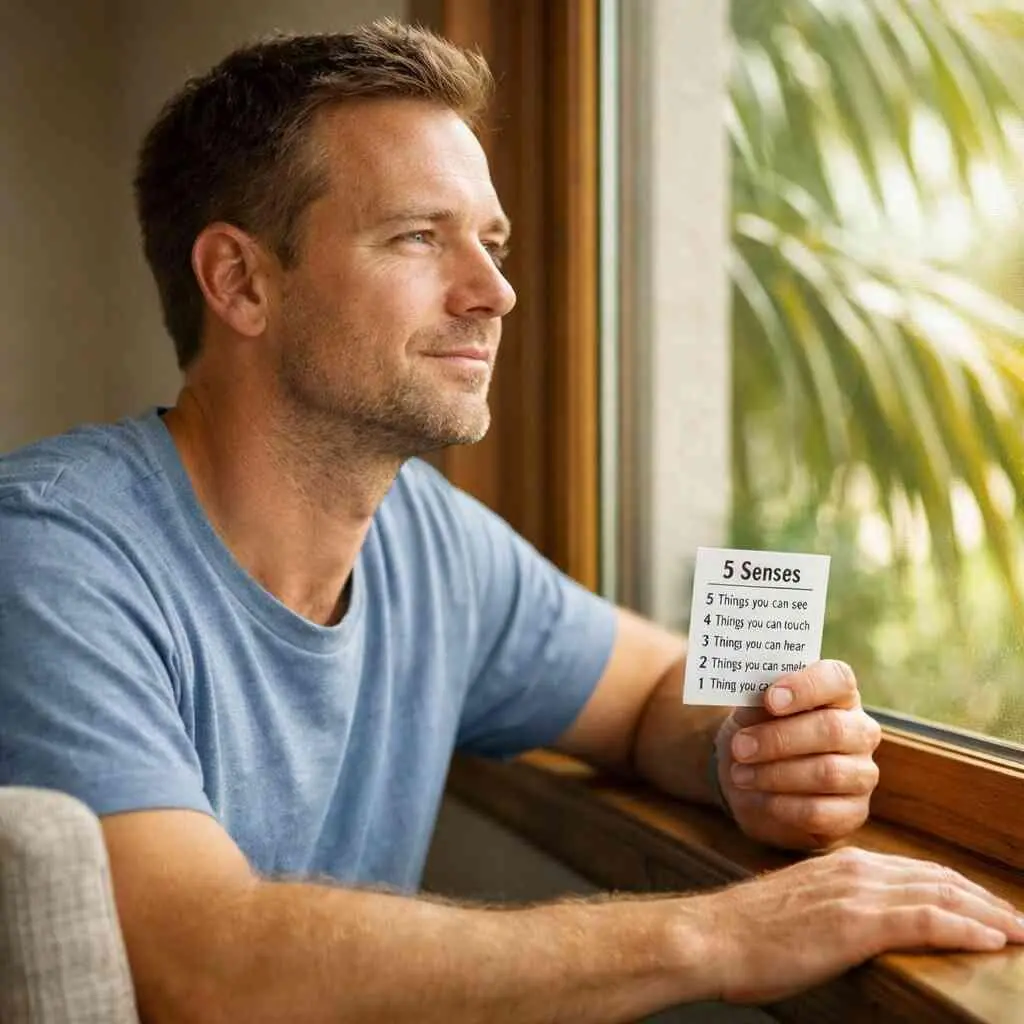
The five senses reset that helps people stay present during peer support in recovery groups
A simple five senses reset is easy to remember and hard to overcomplicate:
- Name five things you see.
- Name four things you feel.
- Name three things you hear.
- Name two things you smell.
- Name one thing you taste.
This is one of the most practical stress management techniques we use in our group therapy setting. It can also pair well with mindfulness meditation and short pauses during intensive outpatient care. For readers who want the clinical frame, the Anxiety & Depression Association of America explains how grounding can reduce the body’s alarm response.
How grounding supports trauma therapy South Florida clients who feel pulled outside their window of tolerance
For clients in trauma therapy South Florida, grounding is often the difference between staying connected and getting pulled outside the “window of tolerance,” the range where your body can process stress without flooding or shutting down. That is especially true in PTSD treatment in group settings, where trigger exposure can happen through stories, sounds, or even silence.
Here is the part most online guides miss: grounding works best when you practice it before you need it. In a structured setting like a residential treatment facility or partial hospitalization program, repetition builds the muscle memory that later supports long-term recovery planning.
-
Naming the Feeling Before It Runs the Group
Naming the feeling is a basic skill, but it changes everything. When you can identify what is happening inside you, you gain more control over your response, which is why emotional awareness exercises are so important in dual diagnosis coping strategies and recovery work.
Why emotional awareness exercises make healthy coping alternatives easier to use in real life
Most people do not relapse or explode because they lack willpower. They act on an emotion they never fully named. When group members practice emotional coping strategies for rehab, they learn to separate sadness from anger, shame from fear, and boredom from craving, which makes healthy coping alternatives easier to use at home.
This matters in depression and addiction and anxiety treatment coping tools, where the body can feel heavy, restless, or numb without a clear label. A person who can say, “I am overwhelmed and embarrassed,” usually has more options than someone who only says, “I feel bad.”
How mood words, body cues, and urge tracking support dual diagnosis coping strategies
I often use a simple tracking sheet in group. It asks for three things: mood words, body cues, and urges.
What you track | What it tells you | Why it helps Mood words | What emotion is present | Builds emotional vocabulary Body cues | Tight chest, nausea, restlessness | Catches early warning signs Urge level | 1 to 10 craving scale | Shows when support is needed
This kind of tracking fits co-occurring disorders support and evidence-based treatment approaches because it makes patterns visible. The National Institute of Mental Health and the National Institute on Drug Abuse both emphasize that substance use and mental health symptoms often overlap and should be treated together.
What clinicians look for when group therapy activities turn into emotional regulation skills practice
When I watch group work, I look for three signs: can the person name the feeling, can they notice body cues, and can they pause before acting? That is the real move from insight to emotional regulation skills.
If someone can say, “My chest is tight, I want to leave, and I am ashamed,” they are already practicing treatment. That is why mental health IOP, dual diagnosis treatment, and outpatient program Delray Beach settings often spend so much time on naming, not just talking.
-
Saying the Hard Thing Without Starting a Fight
Healthy communication is a coping skill because silence, guessing, and defensiveness usually make recovery harder. In group therapy activities, people learn how to ask for what they need, set limits, and repair conflict without turning every hard moment into a blowup.
How healthy communication in recovery changes conflict, silence, and repair
Healthy communication in recovery means speaking clearly, listening without interrupting, and staying with the conversation long enough to resolve something real. That matters in family therapy communication skills, where loved ones may be scared, tired, or unsure what to say.
A client once told me they could handle cravings better than family dinners. That was not because meals were more dangerous. It was because no one had taught them how to say, “I need this conversation to slow down,” without sounding rude or shutting down.
The boundary setting skills and communication skills training people practice in group therapy activities
Group is a safe place to rehearse language before real life needs it. Common exercises include:
- “I” statements instead of blame
- Asking for a pause before escalation
- Saying no without overexplaining
- Naming a need directly
- Repairing after a misunderstanding
These boundary setting skills and communication skills training tools support peer support in recovery groups and social skills practice. They also matter in young adult recovery skills, women’s rehab, men’s recovery, and LGBTQ+ affirmative treatment, where clear communication can protect both dignity and safety.
Why family therapy communication skills matter when loved ones are tired, scared, or unsure what to say
Family members often want to help, but fear makes people clumsy. They may monitor, lecture, withdraw, or say too much at once. In family therapy, we help both sides slow the pace so the conversation can hold real feelings without turning into a fight.
That is one reason many people look at aftercare planning skills, sober support network planning, and family weekend offerings as part of the recovery plan. If family communication improves, the home environment gets steadier.
-
Replacing the Old Reflex with a Skill That Actually Holds
This is where recovery starts to feel more durable. Instead of reacting on autopilot, you learn to catch the thought, test it, and choose a different move. That is the core of cognitive behavioral therapy coping skills, dialectical behavior therapy exercises, and mindfulness meditation in treatment.
How cognitive behavioral therapy coping skills help challenge the thought that leads to use
CBT teaches that thoughts, feelings, and actions influence one another. If the thought is “I already blew it,” the next move may be use, withdrawal, or more shame. If the thought changes to “I had a rough hour, not a ruined day,” the behavior often changes too. 
That is why cognitive behavioral therapy coping skills are used so often in evidence-based treatment and residential treatment facility support. They help people question the story that fuels relapse. For broader context, the American Psychological Association discusses CBT as a well-supported therapy for changing patterns of thought and behavior.
Why dialectical behavior therapy exercises and distress tolerance skills matter during triggers
DBT is especially useful when emotion runs hot. Distress tolerance skills are not about liking pain. They are about getting through a hard moment without making it worse.
Useful dialectical behavior therapy exercises include:
- paced breathing
- temperature change, like cold water on the face
- short movement breaks
- urge surfing
- opposite action when the urge is destructive
These tools are often a fit for trauma-informed group therapy, bipolar disorder therapy, and anxiety treatment because they help people ride out the peak without acting on the first impulse. In a partial hospitalization program, we often coach these skills in the morning and ask clients to practice them again later in the day.
The role of mindfulness meditation in treatment, self soothing strategies, and craving management tools
Mindfulness meditation in treatment teaches you to notice thoughts and sensations without obeying them. That creates space between urge and action. It also pairs well with self-soothing strategies like warm tea, calming music, walking near the water, or quiet breathing before bed.
In a coastal place like Delray Beach, I often encourage people to use the environment wisely. A brief walk after group, a few mindful breaths near the beach, or a stop at a shaded bench can support craving management tools without pretending life is easy. For more structured skill work, our mindfulness meditation and self-regulation education services can help people practice these tools consistently.
-
Turning Group Practice into a Real Life Relapse Prevention Plan
The best group work leaves the room and follows you home. Relapse prevention becomes real when you can spot triggers, ask for help, and use a plan that fits your actual week, not a perfect one.
How problem-solving skills for recovery help with triggers at home, work, and in Delray Beach routines
Problem-solving skills for recovery help you break a hard situation into smaller parts. If a trigger shows up at work, at home, or during a drive along Federal Highway, you do not need a dramatic solution. You need a usable one.
Try this simple sequence:
- Name the problem.
- Identify the trigger.
- List two safe options.
- Choose one action.
- Review what happened.
That approach supports managing triggers in recovery, building resilience in treatment, and recognizing warning signs of relapse. It also works well for people balancing professional obligations, child care, or vocational support needs.
Why accountability in recovery groups, sober support network planning, and aftercare planning skills matter after treatment
Recovery gets steadier when you know who to call and what to say. That is why accountability in recovery groups, sober support network planning, and aftercare planning skills matter so much.
At RECO Immersive, I often see stronger follow-through when clients have a clear post-discharge plan, including therapy, psychiatry, and support groups. For readers comparing levels of care, our program structure can help explain how support shifts from higher structure to more independent care. If insurance is part of your decision, our insurance verification page can help you check benefits before you decide.
How life skills training in rehab connects coping skills for recovery to long-term recovery planning and sober living resources
Life skills training in rehab connects coping skills to the real tasks of living: sleep, meals, money, time, and healthy routine. That is where sober living resources, nutritional counseling, case management, and holistic recovery support matter. Skills get easier to use when your day has structure.
I also encourage people to use continuing care. That may include alumni program support, 12-step alternatives like SMART Recovery, or ongoing therapy after discharge. For many people, that bridge is what keeps progress from slipping when life gets busy again. If you want more context on what happens after treatment, our alumni support page and life skills resources are a good place to start.
If you are looking for a place that treats both mental health and substance use with structure, RECO Immersive is one option in the Delray Beach recovery community. Our team offers a connected path that can include detox, therapy, psychiatric care, and sober living support, all in a setting that keeps the work personal and grounded. If you want to talk through your next move, call +15614644077.
“Reco was one of if not the best facilities that I have been apart of. Great staff that really cared for their clients. They showed levels of leniency that honestly most facilities would not allow. Specifically a lot of leniency towards me specifically. I was making chaos almost every second I was at Reco. Disruptive during groups, pushing boundaries, and going against the flow, amongst other things. At the same time this was my recovery. Some of the things I did was “decorate” my wall with behavioral contracts, show up to the facility without a shirt, and use sugar to simulate cocaine on my dresser. I take accountability for my actions, and accepted the consequences. I did get kicked out. The only thing that was piss poor about the facility was Travis McAllister. Who mind you, was not a therapist nor a physiatrist. Was screaming and cursing in the most disrespectful manner at a client (that was me). Treated me less than garbage at a facility geared towards getting support and recovering. On the other hand Brock McCoy was also brought in to try and reason with me. He sat me down and we had a civil conversation.(this was during the no shirt incident) I still was being uncooperative and not an ounce of negativity coming off of Brock MaCoy. And you know what? He gave me a killer shirt and on top of that, I put my shirt on 30 minutes later. After Travis McAllister Verbally assaulted me, I did stoop down to his level and started saying homosexual words and phrases at him. So yes at the end of the day I was engaging in idiotic behavior( hence RECOVERY facility) which lead to a punishment fitting of the crime. But Screaming, dropping F bombs, and being utterly disrespectful, is completely unprofessional. If you can’t take the heat get out of the Kitchen. Oh…..and one of the most engaged and caring director I’ve ever come across.”– Cristian D., a 5 star review from RECO Immersive on Google Business Reviews
Frequently Asked Questions
How long does detox last at a Delray Beach rehab?
Detox length depends on the substance, the amount used, your health history, and whether alcohol, opioids, benzodiazepines, or multiple substances are involved. Some people need only a few days, while others need longer medical monitoring. If you are asking how long detox lasts, the safest answer is that it should be based on your symptoms and a clinical assessment, not a fixed schedule.
Does RECO Immersive take my insurance?
Insurance coverage varies by plan, network status, and level of care. The best way to find out is through benefits review and insurance verification. RECO Immersive can help you check whether your plan may include Aetna, Cigna, Blue Cross Blue Shield, or out-of-network benefits.
What is PHP vs IOP?
A partial hospitalization program usually offers more weekly structure and clinical time than an intensive outpatient program. PHP often fits people who need more support during the day, while IOP may work better for those stepping down or balancing treatment with more outside responsibilities. The right fit depends on safety, symptoms, and daily stability.
Can group therapy help with depression and anxiety too?
Yes. Group work can help with depression and addiction, anxiety treatment, PTSD treatment, and other co-occurring disorders because it builds coping skills, social connection, and routine. It is not a substitute for individualized care, but it often strengthens it.
What if I need help for addiction and mental health at the same time?
That is exactly what dual diagnosis treatment is for. The care model treats substance use and mental health together instead of separately. If you are dealing with mood swings, panic, trauma, or substance use at the same time, an integrated program is usually the better fit.
Is there help if I am not ready for 12-step groups?
Yes. Many people do better with 12-step alternatives, including SMART Recovery and other skills-based supports. Recovery can include peer groups, therapy, medication-assisted treatment like Suboxone maintenance or Vivitrol injections when clinically appropriate, and a sober support plan that matches your values.
What should I do if I am not sure I need treatment?
Start with an honest screen of the basics: cravings, withdrawal, missed work, family conflict, worsening anxiety, or using more than you meant to. If those signs are showing up, it may be time to call for a confidential assessment. You do not have to sort it all out alone, and you do not need every answer before reaching out.