What is Biofeedback?
Biofeedback is a non-invasive therapy that uses sensors to display real-time data on physiological signals — heart rate, breathing, skin temperature, brain waves — so you can learn to consciously regulate them.
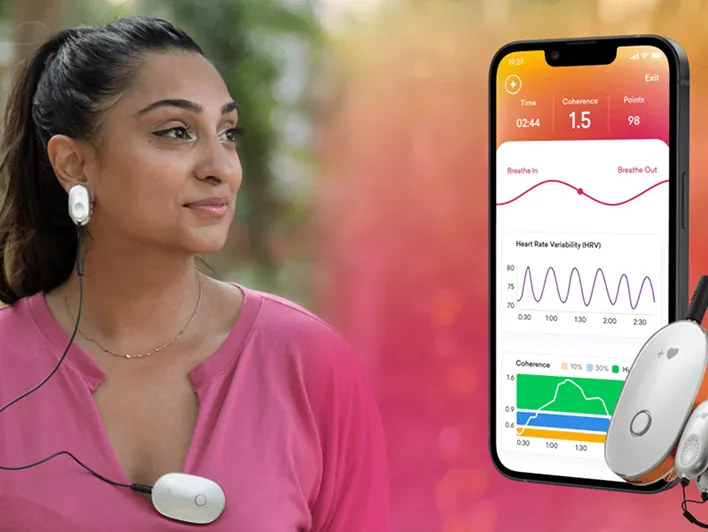
Biofeedback is a non-invasive therapy that uses sensors to display real-time data on physiological signals — heart rate, breathing, skin temperature, brain waves — so you can learn to consciously regulate them.
Many mental health conditions involve dysregulated nervous-system responses. Biofeedback teaches concrete, repeatable skills to calm the body, reduce anxiety, and build resilience that persists beyond treatment.
Through guided practice, you train your nervous system to shift out of fight-or-flight states. The skills become automatic over time, supporting better sleep, emotion regulation, and stress tolerance during and after treatment.

Still not sure?
Curious what a day at RECO Immersive looks like?
Choosing treatment is a big step. We don’t expect you to make this decision lightly. Here’s exactly what your day will look like.
Biofeedback is a non-invasive therapy that translates your involuntary physiology into real-time signals you can see and hear, so you can learn to consciously regulate it. At RECO Immersive in Delray Beach, clinicians attach painless surface sensors that track heart rate variability (HRV) for vagal tone, surface electromyography (EMG) for muscle tension, electroencephalography (EEG, also called neurofeedback) for brain rhythms, and galvanic skin response (GSR) for sympathetic arousal. The data drives an on-screen visual or audio cue — a moving graph, a brightening image, a tone that softens — that changes the moment your nervous system shifts. Over weeks of guided practice, the patterns that calm your physiology become voluntary skills you can deploy outside the clinic when stress, panic, or rumination spike.
Biofeedback has the strongest evidence base for stress-related and autonomically driven conditions. At RECO Immersive we use it to help patients with generalized anxiety, panic disorder, ADHD-related dysregulation, tension-type headache and migraine, hypertension, insomnia, and the gut-brain symptoms of irritable bowel syndrome (IBS) where stress reactivity perpetuates flares. It is also a strong adjunct for post-traumatic stress, where teaching the nervous system to downshift complements trauma-focused psychotherapy. Because biofeedback works by training your own physiology rather than introducing a substance, it pairs well with medication and with our other psychiatric treatments — patients often see medication doses become more effective, or stay effective at lower thresholds, once self-regulation skills are in place.
Neurofeedback is one specific kind of biofeedback. Biofeedback is the umbrella term for any technique that mirrors body signals — heart rate, breathing, skin conductance, muscle tension, temperature — back to the patient for self-regulation. Neurofeedback narrows that lens to the brain itself, using EEG to display brainwave activity (alpha, beta, theta, sensorimotor rhythm) and reward patterns associated with calmer or more focused states. At RECO Immersive, our clinical team often combines both: HRV biofeedback to anchor parasympathetic recovery and address anxious arousal, plus targeted neurofeedback when symptoms point to specific cortical patterns such as ADHD inattention or PTSD hyperarousal. The choice depends on your symptom profile and, when relevant, on findings from a quantitative EEG (qEEG) brain map.
Most patients begin to feel calmer between sessions four and six and reach measurable physiological change — improved HRV, lower resting muscle tension, more stable skin conductance — within six to ten sessions. Headache and hypertension protocols typically run 8 to 12 sessions; anxiety and ADHD protocols often run 20 or more, depending on whether neurofeedback is included. At RECO Immersive we track objective markers session over session so you can see the trajectory rather than guess at it. The skills are durable: published follow-up studies show that gains in HRV biofeedback for anxiety and in EMG biofeedback for tension headache are largely retained 6 to 12 months after treatment ends, especially when patients keep up a brief daily home practice.
Yes — biofeedback has one of the longer evidence trails in behavioral medicine. The American Psychological Association recognizes biofeedback as having efficacy for anxiety, tension and migraine headache, and essential hypertension, and the Association for Applied Psychophysiology and Biofeedback (AAPB) maintains formal evidence ratings across more than a dozen indications. Randomized controlled trials support HRV biofeedback for generalized and performance anxiety, EMG biofeedback for chronic tension headache, thermal biofeedback for migraine prevention, and EEG-based neurofeedback for ADHD. RECO Immersive’s protocols are built directly off these published parameters — session count, sensor placement, training thresholds — rather than improvised, so what you receive in Delray Beach matches what was tested in the literature.
Coverage varies by carrier and indication, but biofeedback is reimbursable on more plans than most patients realize. Many major insurers — including Aetna, Cigna, BlueCross BlueShield, and several United Healthcare plans — cover biofeedback when it is medically necessary for migraine, tension headache, urinary incontinence, certain chronic pain conditions, and treatment-resistant anxiety. Coverage for ADHD-focused neurofeedback is less consistent and often requires documentation of failed first-line treatment. Our admissions team at RECO Immersive in Delray Beach verifies your specific benefits before you start, identifies what authorization is needed, and gives you a written estimate of any out-of-pocket cost so there are no billing surprises mid-course.