Best Holistic Care Options for Anxiety Treatment in Delray
When anxiety in Delray Beach stops feeling like stress and starts running the day If you are reading this because your chest feels tight, your sleep is wrecked, or your thoughts will not slow down, that matters. Anxiety can start quietly and then take over everything. In Delray Beach, people often blame traffic on Atlantic […]

When anxiety in Delray Beach stops feeling like stress and starts running the day
If you are reading this because your chest feels tight, your sleep is wrecked, or your thoughts will not slow down, that matters. Anxiety can start quietly and then take over everything. In Delray Beach, people often blame traffic on Atlantic Avenue, work stress, or “just a rough week.” But when the worry follows you from morning coffee to midnight, something deeper may be going on. That is the point where holistic anxiety treatment in Delray Beach can offer more than temporary relief.
The signs anxiety has moved past normal worry and into daily disruption
Normal worry usually comes and goes. Anxiety that needs care tends to linger, repeat, and interfere with your day. You may forget conversations, double-check simple tasks, or avoid places that used to feel easy. Some people keep smiling through it and still feel exhausted by noon. Others start canceling plans because even small tasks feel heavy.
Here is the part most people miss. Anxiety does not always look dramatic. Sometimes it looks like constant texting for reassurance, stomach pain, or being unable to start the day without a long mental battle. One client in Palm Beach County kept saying he was “just stressed” until he realized he had stopped driving over bridges and was sleeping only three hours a night. That is not weakness. That is a nervous system stuck on high alert.
Why coastal life, work pressure, and trauma history can all amplify symptoms
Delray Beach has a calmer feel than many South Florida cities, but life here still moves fast. Work pressure, money stress, family strain, and the social pace around the beach can all push anxiety higher. For some people, the coastal setting helps. For others, it highlights what they have been avoiding.
Trauma history also matters. A past event can train your body to scan for danger even when nothing is wrong. That is why anxiety often overlaps with South Florida mental health care needs like PTSD treatment, depression and addiction, or bipolar disorder therapy. If you have been through abuse, loss, combat, or chaos at home, the body may react before the mind catches up. The mind says “I’m fine.” The body says otherwise.
When panic, sleep loss, or constant scanning point to a deeper mental health need
Panic attacks, poor sleep, and constant hypervigilance are not just uncomfortable. They can signal that your system needs clinical care. If you wake up already braced for bad news, that is a sign. If your heart races in line at the store, that is a sign. If you are scanning every room, exit, or face for danger, that is a sign too.
The people who improve fastest are not the ones who “push through.” They are the ones who get assessed early and honestly. A thoughtful evaluation can separate anxiety from substance use, trauma, depression, or mood instability. That distinction matters because anxiety care in Delray works best when the real cause is clear.
Why holistic care works better when anxiety is tied to the whole person
Holistic care does not mean avoiding medicine or therapy. It means treating the full picture: sleep, stress, trauma, relationships, body tension, and coping habits. That matters because anxiety rarely lives alone. It often shows up alongside alcohol use, pill misuse, depression, or trauma symptoms. A good South Florida mental health care with evidence-based treatment plan respects that complexity without making it feel overwhelming.
How co-occurring disorders change the treatment plan in real life
Co-occurring disorders, also called dual diagnosis, mean you are dealing with anxiety and another condition at the same time. The second condition may be depression, alcohol use, stimulant use, PTSD, or bipolar disorder. That changes the treatment plan in practical ways. A person drinking to calm panic needs something different from a person whose anxiety is tied to trauma memories. NIDA has long emphasized that co-occurring disorders need integrated care, not separate silos.
This is where dual diagnosis treatment for co-occurring disorders becomes important. If someone is using cocaine, opioids, or benzodiazepines to manage fear, the anxiety and the substance use keep feeding each other. We also see this with prescription pill addiction, alcohol cravings, and withdrawal anxiety. Treatment should address both sides together. If it does not, the cycle usually returns.
What evidence-based treatment means when CBT, DBT, and EMDR are part of care
Evidence-based treatment means the approach has support from research and clinical practice. It does not mean a perfect fix. It means the method has a real reason for being there. For anxiety, cognitive behavioral therapy, or CBT, helps you identify distorted thoughts and replace them with more accurate ones. Dialectical behavior therapy, or DBT, helps with emotion regulation, distress tolerance, and better decisions under pressure.
If trauma is part of the picture, EMDR may also help. EMDR stands for eye movement desensitization and reprocessing. It helps the brain process traumatic memories so they do not feel as sharp. Many people in trauma therapy South Florida programs respond well when CBT, DBT, and EMDR are used together, not as isolated tools. That is why cognitive behavioral therapy and dialectical behavior therapy for anxiety is such a strong clinical pairing.
Where mindfulness meditation, yoga therapy, and art therapy fit without replacing clinical support
Holistic supports are most useful when they calm the body and help you practice new skills. Mindfulness meditation trains attention. Yoga therapy can reduce muscle tension and improve breath control. Art therapy can help when words are hard to find. Group settings can also make those skills feel safer to try.
Still, these supports should not replace clinical care when symptoms are severe. Think of them as stabilizers, not substitutes. A person in an outpatient program Delray Beach may use breathing work before a hard family conversation. Another may use drawing or movement after a panic spike. That is why mindfulness meditation and yoga therapy for holistic recovery and art therapy and group therapy activities for recovery can help anxiety feel more manageable in daily life.
Why medication management may help when anxiety overlaps with depression or bipolar disorder
Some anxiety improves with therapy alone. Some does not. If anxiety overlaps with depression or bipolar disorder, medication management may help steady mood and reduce extremes. That is especially important if sleep is broken, energy is unpredictable, or panic is fueled by mood swings. Medication does not solve everything, but it can make therapy usable.
Here is the important part. Medication should be reviewed by a qualified clinician who watches for side effects, interactions, and changes over time. People sometimes fear medication because they worry it will numb them. In careful hands, the goal is the opposite. The goal is to help you think clearly enough to use your coping skills. For some people, medication management for anxiety and mood disorders becomes the bridge between surviving and participating.
The Delray Beach treatment mix that actually matches different levels of need
There is no single level of care that fits everyone. Some people need weekly support. Others need daily structure. Some need a place to stabilize before they can function at home. The best Delray Beach rehab plan matches the intensity of care to how risky life feels right now.
When outpatient program Delray Beach care makes sense and when a higher level of support is safer
An outpatient program can work well when you are stable, safe, and able to sleep, work, and handle basic routines. It often fits people with mild to moderate anxiety, or those stepping down from more intensive care. But if you are missing work, not eating, or using substances to get through the day, outpatient alone may be too light.
The question is not what sounds convenient. The question is what keeps you safe and moving forward. A Delray Beach outpatient program for anxiety support can be a strong fit when you still have structure at home and can attend regularly. If your home environment is chaotic, then a more supportive level may be needed first.
What PHP vs IOP means for someone balancing work, family, and recovery
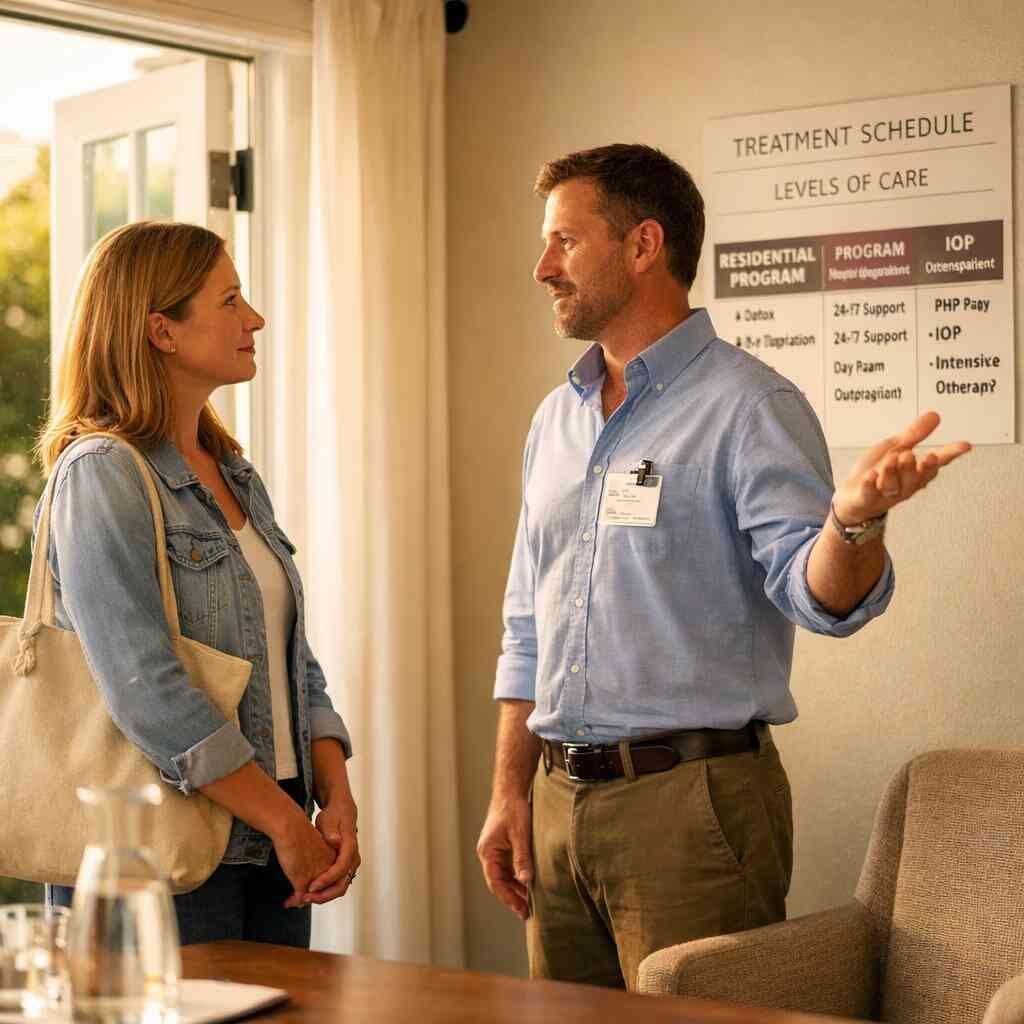
PHP means partial hospitalization program. It usually provides more hours of support each week and more clinical structure. IOP means intensive outpatient program. It gives substantial support while leaving more room for work, childcare, or school. Many families ask what the difference is because both sound intensive.
The simplest answer is this: PHP is more time and more containment. IOP is more flexible, but still structured. If you are juggling a job, two kids, and recovery on top of it, IOP may be realistic. If symptoms are sharper or more unstable, PHP may be safer. Our team often points people toward partial hospitalization and intensive outpatient care in Delray Beach when they need that clear comparison.
Level of careTypical fitMain benefitPHPHigher symptoms, more structure neededStrong daily supportIOPModerate symptoms, more flexibility neededBalance of care and lifeOutpatientStability already presentMaintenance and follow-through### How a residential treatment facility can help when symptoms feel too unstable for home
A residential treatment facility can help when anxiety is severe, sleep is nearly gone, or substance use is making things worse. It gives you round-the-clock structure, fewer triggers, and close clinical monitoring. That matters if you cannot trust your own routine yet. It also helps when home stress keeps undoing progress.
One client from Broward County said every night felt like a fight with his own thoughts. He could not stop drinking, could not sleep, and was missing work. Residential care gave him a quieter setting, a steady schedule, and a chance to reset his nervous system. For people in that spot, residential treatment facility options in Delray Beach can be a meaningful stabilizing choice.
Why dual diagnosis treatment often needs case management, family therapy, and aftercare planning together
When anxiety and substance use show up together, treatment should not stop at symptom relief. Case management helps coordinate appointments, referrals, and practical needs. Family therapy helps the home system stop working against recovery. Aftercare planning helps you keep support after the main program ends. 
That combination matters because recovery is not only about feeling better in the room. It is about functioning on a Tuesday afternoon, after a hard phone call, without returning to old coping habits. Aftercare planning and relapse prevention for long-term recovery can include sober living resources, alumni support, and ongoing therapy. For many people, that is where long-term stability starts to take root.
What happens inside a strong anxiety program beyond talking about feelings
A good anxiety program does more than ask how you feel. It looks at triggers, habits, physical symptoms, family stress, sleep, and substance use. It also gives you skills you can practice the same day. That is the difference between a general chat and real treatment.
How licensed clinicians use initial evaluation and consultation to map symptoms and triggers
The intake process should feel thorough, not rushed. Licensed clinicians usually ask about symptoms, sleep, panic, medications, substance use, trauma history, and safety concerns. They also ask what makes anxiety worse and what helps even a little. That information guides the care plan.
Here is what real feedback can sound like when people find the right environment:
“Reco was one of if not the best facilities that I have been apart of. Great staff that really cared for their clients. They showed levels of leniency that honestly most facilities would not allow. Specifically a lot of leniency towards me specifically. I was making chaos almost every second I was at Reco. Disruptive during groups, pushing boundaries, and going against the flow, amongst other things. At the same time this was my recovery. Some of the things I did was “decorate” my wall with behavioral contracts, show up to the facility without a shirt, and use sugar to simulate cocaine on my dresser. I take accountability for my actions, and accepted the consequences. I did get kicked out. The only thing that was piss poor about the facility was Travis McAllister. Who mind you, was not a therapist nor a physiatrist. Was screaming and cursing in the most disrespectful manner at a client (that was me). Treated me less than garbage at a facility geared towards getting support and recovering. On the other hand Brock McCoy was also brought in to try and reason with me. He sat me down and we had a civil conversation.(this was during the no shirt incident) I still was being uncooperative and not an ounce of negativity coming off of Brock MaCoy. And you know what? He gave me a killer shirt and on top of that, I put my shirt on 30 minutes later. After Travis McAllister Verbally assaulted me, I did stoop down to his level and started saying homosexual words and phrases at him. So yes at the end of the day I was engaging in idiotic behavior( hence RECOVERY facility) which lead to a punishment fitting of the crime. But Screaming, dropping F bombs, and being utterly disrespectful, is completely unprofessional. If you can’t take the heat get out of the Kitchen. Oh…..and one of the most engaged and caring director I’ve ever come across.”– Cristian D., a 5 star review from RECO Immersive on Google Business Reviews
This is where experience matters. A careful clinician does not assume every racing thought is the same. They look for patterns. Is the anxiety tied to trauma? To withdrawal? To mood shifts? To social fear? Those details change treatment choices. If you are comparing how to choose a rehab near Palm Beach County, this level of assessment should be part of the answer.
Why group therapy activities, family therapy, and life skills training matter for lasting change
Group therapy helps you practice new habits with real people, not just in theory. It also reduces shame, which is often a hidden driver of anxiety. Family therapy can repair communication patterns that keep tension alive at home. Life skills training helps with routines, scheduling, boundaries, and stress management.
Here is what almost no online guide mentions. People often improve faster when their daily life gets simpler. That means meals, sleep, rides, work planning, and fewer surprises. Delray Beach and greater South Florida have a strong recovery community, but support works best when it is organized. That is why family therapy for co-occurring disorders and structured skills work are so valuable.
How trauma therapy South Florida programs use EMDR trauma therapy and grounding tools
Trauma therapy should never push too fast. Good programs start with stabilization. Grounding tools, paced breathing, and orientation exercises help you stay in the present. EMDR may come later, when you are ready to process painful memories safely.
If anxiety comes with flashbacks, body tension, or panic around certain sounds or places, trauma work may be essential. A beachside recovery setting can feel calming, but structure still matters. Treatment should not rely on scenery alone. It should use clinical methods that help the body learn safety again. That is why EMDR trauma therapy in South Florida is often paired with grounding and coping practice.
Where holistic recovery supports fit such as nutritional counseling, exercise, and mindfulness meditation
An anxious body often needs steadier fuel. Skipped meals, caffeine overload, poor hydration, and too little movement can make symptoms worse. Nutritional counseling can help you see how blood sugar swings affect mood. Exercise can discharge stress chemicals that keep you wound tight. Mindfulness meditation can slow the loop of catastrophic thinking.
These supports work best when they are simple and repeatable. A ten-minute walk, a regular breakfast, and a short breathing practice can matter more than a perfect routine. The goal is not perfection. The goal is consistency. If you are exploring mindfulness meditation and yoga therapy for holistic recovery, look for programs that teach skills you can carry home.
How medication-assisted treatment or psychiatric support may be considered when needed
Sometimes anxiety sits beside opioid, alcohol, or stimulant use. In those cases, psychiatric support and medication-assisted treatment may be considered. FDA-approved options such as Suboxone maintenance or Vivitrol injections can help some people reduce cravings and stay safer. That can lower the panic that comes from withdrawal or repeated relapse.
This is never one-size-fits-all. Medication-assisted treatment should be matched to diagnosis, history, and goals. It also works best with therapy, not instead of it. If a person is trying to stop heroin, fentanyl, or prescription pill addiction, the nervous system may need help before deeper therapy can land. In those situations, careful medical support can make recovery possible.
What to look for before you choose a rehab near Atlantic Avenue or anywhere in South Florida
Picking care in Delray Beach can feel confusing fast. Insurance, levels of care, and program styles all sound similar at first. They are not. A smart comparison protects your time, money, and mental energy. It also helps you avoid a place that sounds polished but lacks structure.
How to compare insurance verification, self-pay options, and out-of-network benefits without guesswork
Start with coverage questions before admission. Ask what your plan covers, what your out-of-pocket costs may be, and whether the program is in-network or out-of-network. If you have Aetna, Cigna, or Blue Cross Blue Shield, the details still need review because plans differ. Self-pay options should also be explained clearly.
If a center cannot explain benefits in plain language, keep looking. That conversation should not feel like a maze. A solid admissions team can help with insurance verification for Delray Beach rehab and answer practical questions without pressure. That is especially important if you are comparing Florida rehabs that take insurance and trying to act quickly.
What Joint Commission accreditation, DCF licensing, and licensed clinicians can signal
Credentials matter because they tell you a facility meets outside standards. Joint Commission accreditation can signal strong quality and safety processes. DCF licensing matters in Florida because it shows the program is operating under state oversight. Licensed clinicians matter because anxiety care should be guided by trained professionals, not guesswork.
Do not stop at a logo on a website. Ask what it means in practice. Ask who runs groups, who handles medication reviews, and how emergencies are handled. A trustworthy program should answer directly. If the answer feels vague, that is useful information too.
Why beachside recovery and a coastal healing environment should still come with structure and accountability
Delray Beach has a calming environment, and that can support recovery. The ocean air, nearby nature preserves, and slower morning pace can help the body settle. But beauty alone does not treat anxiety. Real progress still needs schedule, attendance, feedback, and accountability.
That balance matters near Atlantic Avenue and throughout South Florida. A treatment setting can feel peaceful without being loose. The best programs combine calm surroundings with clinical rigor. That is the difference between pleasant and effective.
How to ask about alumni program support, sober living resources, and relapse prevention before admission
Before you enter care, ask what happens after discharge. Ask about alumni program access, sober living resources, family weekend, and relapse prevention planning. Ask how the program supports people after the first wave of relief fades. That is when many people need the most structure.
Here is a simple checklist you can use:
- Ask how aftercare is built before discharge.
- Ask what happens if anxiety spikes again.
- Ask whether alumni support is active and easy to use.
- Ask if the program coordinates with outside therapists or doctors.
- Ask how relapse prevention is taught, not just mentioned.
Programs with strong continuing support tend to align better with long-term recovery. If you want a local place that understands the Delray Beach recovery community, RECO Intensive alumni and related support services may be worth reviewing alongside your other options. You do not have to figure this out alone, and you do not have to do it all today. Start with one call and one honest conversation.
Frequently Asked Questions
Question: What makes RECO Immersive a strong choice for holistic anxiety treatment in Delray Beach?
Answer: RECO Immersive offers a compassionate, clinically grounded approach to anxiety treatment in Delray that looks at the whole person, not just the symptoms. For people who need South Florida mental health care that feels personalized, the program can combine evidence-based treatment like cognitive behavioral therapy, dialectical behavior therapy, and EMDR trauma therapy with holistic supports such as mindfulness meditation, yoga therapy, art therapy, and group therapy activities. That matters when anxiety is tied to co-occurring disorders, depression and addiction, PTSD treatment needs, or bipolar disorder therapy. The goal is to help clients build coping skills, reduce overwhelm, and move toward long-term recovery with licensed clinicians and structured aftercare planning. If you are searching for a Delray Beach rehab that understands both the clinical and human sides of anxiety, this kind of integrated care can be a meaningful fit.
Question: How do I know whether outpatient program Delray Beach care, mental health IOP, or a partial hospitalization program is right for me?
Answer: The right level of care depends on how disruptive your symptoms are and how much structure you need each day. An outpatient program Delray Beach option may work well if you are stable, safe, and able to maintain work, family, and daily responsibilities. A mental health IOP or intensive outpatient program can provide more support while still allowing flexibility for home life, school, or work. A partial hospitalization program usually offers a higher level of daily structure and may be better when anxiety feels more severe or when co-occurring disorders, substance use, or mood instability are involved. RECO Immersive can help you understand what PHP vs IOP means in real life and guide you toward the level of care that fits your situation. That kind of assessment is especially important if you are comparing Florida addiction treatment options, inpatient rehab Palm Beach County programs, or a more flexible outpatient plan.
Question: Can RECO Immersive help if my anxiety is connected to addiction, withdrawal, or dual diagnosis treatment needs?
Answer: Yes, that is often where integrated care becomes especially important. Anxiety can show up alongside alcohol use, cocaine use, opioid rehab needs, fentanyl treatment, heroin recovery, prescription pill addiction, or benzodiazepine withdrawal, and each of those situations can intensify the nervous system response. RECO Immersive supports dual diagnosis treatment and co-occurring disorders with a treatment plan that can include psychiatric support, therapy, case management, and medication-assisted treatment when clinically appropriate. For some clients, options such as Suboxone maintenance or Vivitrol injections may be part of a broader recovery plan, always paired with therapy and relapse prevention. This integrated model can be especially helpful for people seeking South Florida detox, drug rehab near me support, or an alcoholism treatment center that understands how anxiety and substance use reinforce one another.
Question: What holistic recovery services are available through RECO Immersive besides therapy sessions?
Answer: A strong holistic recovery plan often includes more than talk therapy, and RECO Immersive reflects that approach. Depending on your needs, care may include mindfulness meditation, yoga therapy, art therapy, nutritional counseling, family therapy, and life skills training to help stabilize both mind and body. These supports can improve coping skills, reduce daily stress, and make it easier to follow through with treatment. They can also pair well with group therapy activities and family weekend programming when families need better communication and structure. For many clients, these services work best alongside evidence-based treatment and personalized planning for aftercare support, sober living resources, and alumni program connection. If you want beachside recovery with a coastal healing environment but still need real accountability, this balance can be especially valuable.
Question: What should I ask before choosing a private rehab or Florida rehabs that take insurance like Aetna, Cigna, or Blue Cross Blue Shield?
Answer: Before choosing any program, it helps to ask about insurance verification, out-of-network benefits, and self-pay options so you know what to expect before admission. You should also ask how the intake process works, whether licensed clinicians will be involved in your care, and how the program supports aftercare planning, relapse prevention, and long-term recovery. If you are comparing private rehab options in the Delray Beach recovery community, it is also reasonable to ask about Joint Commission accreditation, DCF licensed status, alumni program access, and whether the facility offers specialized support such as young adult rehab, LGBTQ+ affirmative treatment, veterans addiction help, gender-specific treatment, women’s rehab, or men’s recovery. RECO Immersive can help you think through how to choose a rehab without pressure, so you can make a decision that fits your needs, your goals, and your life.