Transcranial Magnetic Stimulation (TMS)
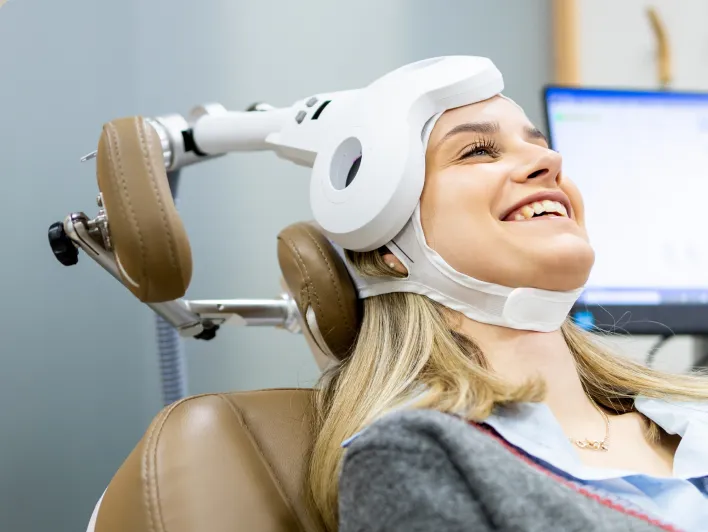
Transcranial Magnetic Stimulation (TMS) is an FDA-approved treatment that uses magnetic pulses to activate specific parts of the brain that are underactive in people struggling with depression and other mental health conditions. The treatment is painless and done while you are awake and relaxed. A small device is placed on your head and delivers focused stimulation to help rebalance brain activity.
For some people, traditional treatments like therapy or medication are not enough. TMS offers an alternative that directly targets the brain’s mood-regulating areas. It can be especially effective for people with treatment-resistant depression or those looking for a drug-free option with minimal side effects.
TMS helps improve mental health by reactivating parts of the brain that may be sluggish or disconnected due to depression. Over time, this can lead to better mood, clearer thinking, and a greater sense of emotional stability. It is a safe and well-studied option for people seeking a new path toward healing and long-term mental wellness.

TMS therapy questions, answered
What is TMS therapy and how does it work?
Transcranial Magnetic Stimulation (TMS) is an FDA-cleared, non-invasive treatment that uses targeted magnetic pulses to stimulate the dorsolateral prefrontal cortex — a brain region underactive in major depressive disorder. A coil placed against the scalp delivers focused electromagnetic energy that depolarizes neurons in the targeted circuit. There are no needles, no anesthesia, and no recovery time.
How effective is TMS for treatment-resistant depression?
Across published clinical trials, response rates for TMS in treatment-resistant depression range from 50% to 60%, with remission rates of 30% to 40%. At RECO Immersive, we use qEEG brain mapping to guide coil placement, which has been shown to further improve outcomes compared to standard 5cm-rule positioning. Patients who have failed two or more SSRI or SNRI trials are often the strongest TMS candidates.
How long does a TMS treatment course take?
A standard TMS course is 36 sessions delivered five days per week over six to eight weeks. Each session lasts 19 to 37 minutes depending on the protocol (standard rTMS, theta-burst, or accelerated). Most patients begin noticing mood improvements between sessions 10 and 20, with the full therapeutic benefit emerging by the end of the course.
Is TMS therapy painful or do you feel anything during treatment?
TMS is not painful, though most patients report a tapping or knocking sensation on the scalp during pulses. Mild scalp tenderness or a transient headache is the most common side effect, usually fading within an hour and resolving entirely after the first week of treatment. Patients remain awake, alert, and able to drive themselves home immediately afterward.
Does insurance cover TMS therapy at RECO Immersive?
Most major insurance plans (Aetna, BlueCross BlueShield, Cigna, United Healthcare, Optum, Magellan, Humana) cover TMS for adults diagnosed with major depressive disorder who have failed at least one to four medication trials, depending on the carrier. Our admissions team will verify your benefits and obtain prior authorization before any out-of-pocket commitment.
What conditions besides depression can TMS treat?
Beyond major depressive disorder, TMS has FDA clearance for obsessive-compulsive disorder (OCD), smoking cessation, and anxious depression. Off-label evidence supports its use for generalized anxiety, post-traumatic stress disorder (PTSD), bipolar depression, and certain post-concussive symptoms. RECO Immersive offers all FDA-cleared indications and select off-label protocols when supported by qEEG findings.